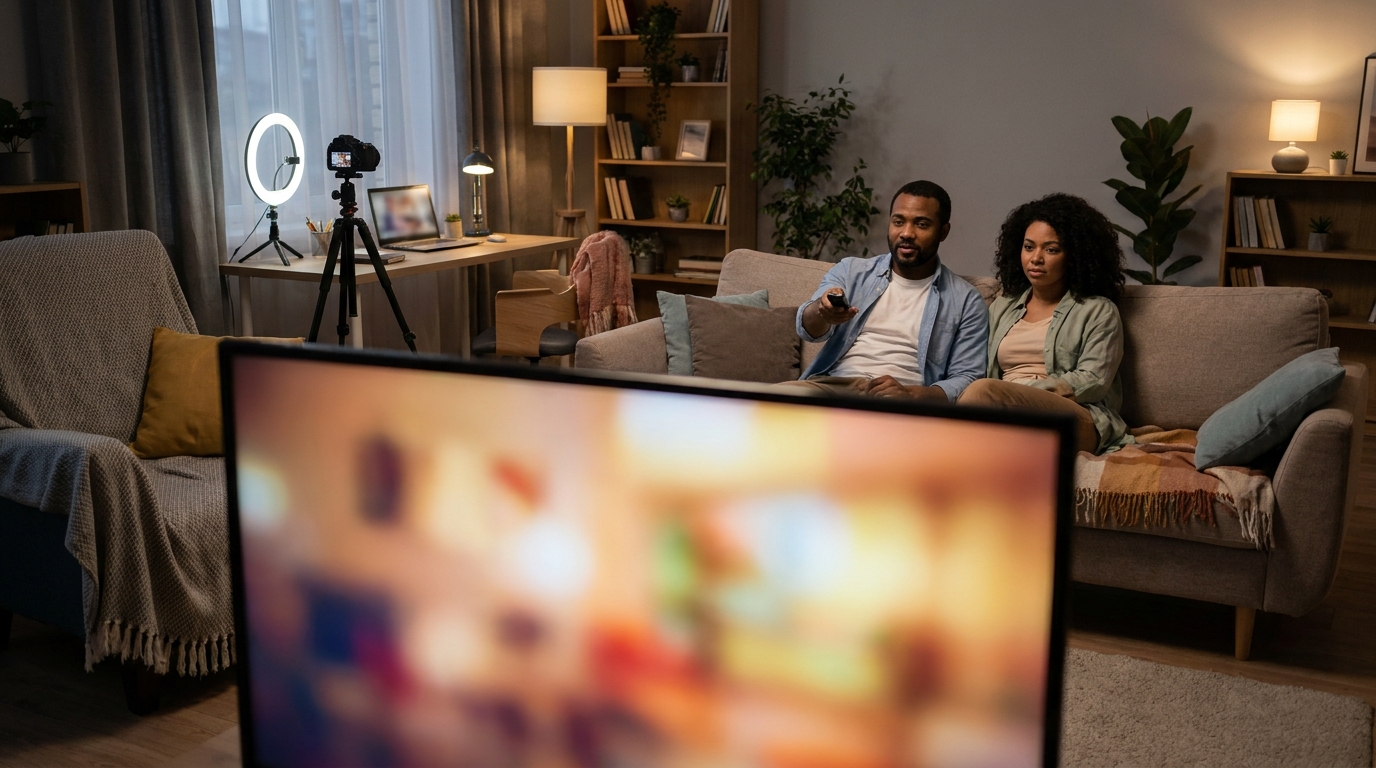
YouTube's share of TV viewing reached 15.8% of all US TV watch time in August 2026, according to Nielsen's August 2026 Gauge reports. That share is larger than any other media company's, Disney included. For creators, it means a large part of their audience already watches YouTube videos on a living room TV.
What is YouTube's share of TV viewing right now?
The latest reading is Nielsen's Media Distributor Gauge for August 2026, released October 22, 2026. It puts YouTube at 15.8% of US TV watch time. Nielsen ranks distributors in that report, and YouTube held first place.
The rest of the top six in the same August report:
Rank
Media distributor
Share of US TV time, August 2026
1
YouTube
15.8%
2
Disney
9.3%
3
Netflix
7.7%
4
NBCU+Versant
just under 7.7% (0.03 points behind Netflix)
5
Paramount
6.8%
6
FOX
5.6%
Nielsen's August report gives YouTube 15.8% and Disney 9.3%, so YouTube led the second-place company by 6.5 share points. Nielsen also put streaming as a whole at 49.6% of TV time that month.
August was a quiet month for TV overall. Nielsen reported a 4.4% drop in total TV usage after the FIFA World Cup 2026 ended in July and the school year started. Streaming and cable still gained share in that month, because their viewing fell less than the total did.
What the Gauge counts, and what it leaves out
The Gauge is Nielsen's monthly report on how US audiences split their TV time between broadcast, cable, streaming and other sources. The Media Distributor Gauge, which Nielsen added in April 2024, groups the same viewing by the company behind it. YouTube's 15.8% comes from the distributor report. If you need the surrounding vocabulary (CTV, AVOD, linear), see our list of streaming TV terms defined.
It comes from panels. According to Nielsen's Gauge methodology notes, streaming data comes from Streaming Meter-enabled homes inside Nielsen's National TV panel. Each month's linear viewing is Live+7, meaning live viewing plus up to seven days of delayed viewing.
It counts all viewing, ads or not. Nielsen states in its May 2026 Gauge release that The Gauge and the Media Distributor Gauge include ad-supported and non-ad-supported viewing. Nielsen's currency ratings, used to sell advertising, are a separate product.
It measures the YouTube platform. The share is YouTube videos played on TV sets. YouTube TV, Google's paid live TV subscription, is a different product.
The first point matters for creators: your TV audience is part of your audience, and every phone view sits outside this Nielsen figure.
How YouTube's TV share has grown since 2025
Nielsen's monthly Gauge releases show YouTube's share climbing, with each report noting a new high. Our FAST industry statistics hub collects these and other sourced viewing figures in one place.
From April 2025 to August 2026, YouTube's share rose by 3.4 points (15.8 minus 12.4). Streaming's share rose by 5.3 points over the same span (49.6 minus 44.3). In April 2025, Nielsen also noted that YouTube had added 2.8 points since April 2024.
Monthly readings move with the calendar. Big live events pull viewers to broadcast, and summer and school breaks shift streaming time. A single month is a snapshot; the trend across several months is more informative.
Why the share keeps rising: viewing is moving to the TV set
Part of YouTube's growth on Nielsen's TV-only measure comes from people watching more of YouTube on the TV itself. Digital i, a UK analytics firm, released The YouTube Era: 2025 in Review on June 3, 2026. It covers 20 international markets. Digital i found TV's share of YouTube viewing time rose from 28% in January 2024 to 35% in December 2025. Over the same period, mobile's share fell from 35% to 31%.
This is Digital i's own measurement, a separate study from Nielsen with a different method and a global scope, so the two sets of figures should not be combined. Both point the same way, though: more YouTube watching now happens on the biggest screen in the house. Digital i also reported that average daily YouTube use per account rose from 87.2 minutes in 2024 to 99.1 minutes in 2025.
TV viewing is lean-back viewing. The set is often shared, the session runs longer, and the remote does less work than a thumb on a phone. Some of that time looks a lot like the channels people leave on in the background: something playing while the household cooks, works or talks.
What the number means for creators
A 15.8% share of US TV time is a measure of audience, and creators should read it that way. The people who watch your videos increasingly do it from a sofa, at a distance, sometimes with family in the room. That changes a few practical choices:
Picture and sound on a large screen. Captions, readable on-screen text and clean audio hold up at couch distance.
Length and flow. A library of longer videos, or videos that play well back to back, suits viewers who keep one video running into the next.
Format. Short vertical clips can play on TVs too, though they need framing choices. Our guide to vertical video on TV screens covers microdramas and how short clips get programmed for TV.
How your work reaches the TV viewer differs by format. On YouTube, the viewer picks each video. Traditional TV works the other way: a channel runs a schedule, and the viewer tunes in to whatever is on. If you want to understand that model, our explainer on how linear TV scheduling works covers why scheduled channels outlasted cable. A continuous channel suits the kind of always-on, shared-screen viewing the Nielsen and Digital i numbers describe.
None of this replaces YouTube. A creator whose audience watches on TVs can treat a scheduled channel as a second place for the same library, aimed at viewers who want something playing without choosing each video.
Can I turn my YouTube channel into a TV channel?
Yes. A creator can program an existing video library as a FAST channel, a free ad-supported streaming TV channel that plays 24/7 on a schedule. That is a different thing from a YouTube channel page, where viewers pick individual uploads on demand. Our explainer on what a FAST channel is covers how the model works and who runs them.
Vidiyo is our product, and it is one way to do this. Vidiyo is a FAST channel platform: creators upload files or import from YouTube, then place videos on a weekly schedule grid or let auto-fill cover the gaps, and the channel plays 24/7 from that grid. Vidiyo handles transcoding, captions for every upload, playout, the apps and ad serving. There is no application to start a channel. Creating and running a channel is free, per Vidiyo's pricing page, and creators earn an ad revenue share of 60% to 90% by tier, along with live gifts, paid episodes and shoppable tags. Creators own their content and audience data and can export both at any time.
Viewers watch Vidiyo channels in any browser and in the Vidiyo apps for iPhone, Android, Roku and Apple TV. Vidiyo's apps page lists Fire TV, Android TV and Google TV, Samsung, LG and Vizio as coming soon. Our help page shows where viewers watch on TV apps today.
A Vidiyo channel plays in Vidiyo's own apps. It is not a carriage deal with Samsung TV Plus, Pluto TV, Tubi, The Roku Channel or any other third-party free streaming service, each of which runs its own partner process. If you are still deciding whether a scheduled channel is worth running next to your uploads, our comparison of running a FAST channel versus YouTube sets out the trade-offs in audience, programming and revenue.
YouTube share of TV viewing: what it means for creators · Vidiyo Learn
 Vidiyo