 Vidiyo
FAST Channel Analytics: What to Measure and What It Means
The key metrics for FAST channel operators: concurrent viewers, average watch time, ad impressions, fill rates, CPMs, and how to use analytics to make programming and scheduling decisions.

FAST channel analytics are fundamentally different from YouTube analytics. YouTube measures clicks, views, and subscriber growth. FAST measures viewership patterns more like traditional TV: concurrent viewers, tune-in rates, time-shifted viewing, and average commercial break exposure.
Understanding what to measure, what it means, and how to act on it separates operators who grow from operators who plateau.
Quick answers
What is the single most useful viewership metric? Monthly viewing hours. It weights long sessions and maps cleanly to ad inventory.
What session length suggests a problem? Under about 15 minutes often points to content, schedule, or buffering issues.
What fill rate drop should trigger a technical check? A sudden drop below about 30% is often configuration or ad-server health before demand collapse.
How often should I review analytics? Weekly for concurrent viewers, hours, fill, and dropouts. Monthly for eCPM, top titles, and dayparts.
Where do CPM planning bands live? FAST CPM benchmarks 2026.
Core viewership metrics
Concurrent viewers
The number of devices actively watching your channel at any moment. This is the most immediate signal of channel health.
What to track:
- Peak concurrent viewers (what's the max you've hit?)
- Typical concurrent viewers by daypart (how many watch at 8 PM vs. 2 AM?)
- Trend over time (growing, flat, or declining?)
Benchmark: A new independent channel typically starts under 50 concurrent viewers. A healthy mid-sized channel runs 200-1,000 concurrent. Large channels run 5,000+.
Monthly viewing hours
Total hours of content consumed across all viewers in a month. More useful than raw view count because it weights long-form viewing appropriately.
Why it matters: Monthly viewing hours is the primary metric ad networks use to price your inventory. More hours = more ad impressions = more revenue potential.
Average session length
How long a typical viewer watches in a single session before leaving.
Benchmark: TV watching sessions average 30-60 minutes. Short sessions (under 15 minutes) suggest the channel isn't holding attention: possibly a content issue, a scheduling issue, or technical problems (buffering).
Tune-in rate by show
Which content is triggering tune-ins? When you premiere a new show or move content to a primetime slot, does your concurrent viewer count increase?
Tune-in spikes around specific titles tell you which content your audience comes to your channel specifically to watch. These are your "tent pole" titles: worth protecting in your schedule.
Ad metrics
Ad impressions
The total number of ads served across all viewers. Impressions = concurrent viewers × ad breaks per hour × hours watched.
Fill rate
The percentage of available ad break inventory that was filled with a paying advertiser. Critical for revenue optimization. See Ad fill rate optimization for a deep dive.
eCPM (effective CPM)
Your blended revenue per thousand impressions, accounting for both fill rate and CPM. Calculated as:
eCPM = (Total ad revenue / Total ad impressions) × 1000
eCPM is the most useful single-number summary of ad monetization efficiency. A high gross CPM with low fill produces a lower eCPM than a moderate CPM with high fill.
Programming analytics
Content performance by title
Which shows or episodes have the highest average watch time? The highest tune-in rates? The best viewer retention (people who start watching and don't leave)?
This tells you what to program more of, what to put in primetime, and what to de-emphasize.
Dropout rate by position in schedule
If viewers consistently leave after a specific show ends, the following show may be a weak link in the programming chain. Re-order your schedule so strong content follows strong content.
Time-to-tune-in on channel launch
How quickly do viewers start watching after the channel first becomes visible to them (from discovery)? Longer time-to-first-view suggests the channel listing (name, description, thumbnail) isn't compelling enough to trigger immediate tune-in.
What to watch weekly
A practical weekly analytics review:
- Concurrent viewers: peak and typical. Is this week's peak higher or lower than last week's?
- Total viewing hours. Month-over-month trend is more meaningful than week-over-week for small channels.
- Fill rate. Has anything changed since last week?
- Dropout points. Did any slot changes this week affect dropout patterns?
Monthly review:
- eCPM trend: are you getting more efficient at monetization?
- Top 10 content pieces by total viewing time
- Daypart performance: which time windows are growing?
Warning signs
Suddenly lower concurrent viewers: Check for technical issues first (buffering, stream outage, EPG errors). If technical is fine, look at schedule changes: did you move a tent-pole show?
Fill rate drop below 30%: Check your ad tag, your SSAI configuration, and your ad server health. A fill rate drop is often a configuration problem before it's a demand problem.
Session length dropping: Indicates content quality or schedule quality problems. Viewers are finding less reason to stick around.
Viewership not growing after 3 months: Check your content freshness (are you adding new content?) and your channel promotion (are you doing any?). Organic FAST discovery is slow without content additions.
Benchmarks by channel size
| Monthly viewing hours | Typical concurrent viewers | Typical eCPM (US) | Monthly revenue estimate |
|---|---|---|---|
| 5,000 | 10-30 avg | $3-$6 | $75-$150 |
| 25,000 | 50-150 avg | $5-$10 | $625-$1,500 |
| 100,000 | 200-500 avg | $7-$14 | $4,375-$8,750 |
| 500,000 | 1,000-2,500 avg | $9-$18 | $27K-$56K |
These are illustrative. Actual numbers vary enormously by content category, US vs. global audience mix, and monetization setup. They are planning aids, not Vidiyo marketplace averages.
How to turn metrics into schedule changes
Analytics only matter when they change the grid.
If primetime concurrent is flat but overnight is growing: You may be programming for the wrong daypart. Move tent poles to where viewers already arrive.
If one title spikes tune-in then dumps viewers: Keep the title, fix the follow-up. Weak lead-outs waste acquisition.
If eCPM rises while hours fall: You may be over-optimizing inventory quality at the expense of audience. Balance rate and volume.
If fill is healthy but sessions are short: Demand is fine; programming is not. Fix retention before you chase more distribution doors.
Programming tactics: FAST channel programming strategy. Break design: designing ad breaks for FAST channels.
Where these numbers live in Vidiyo Studio
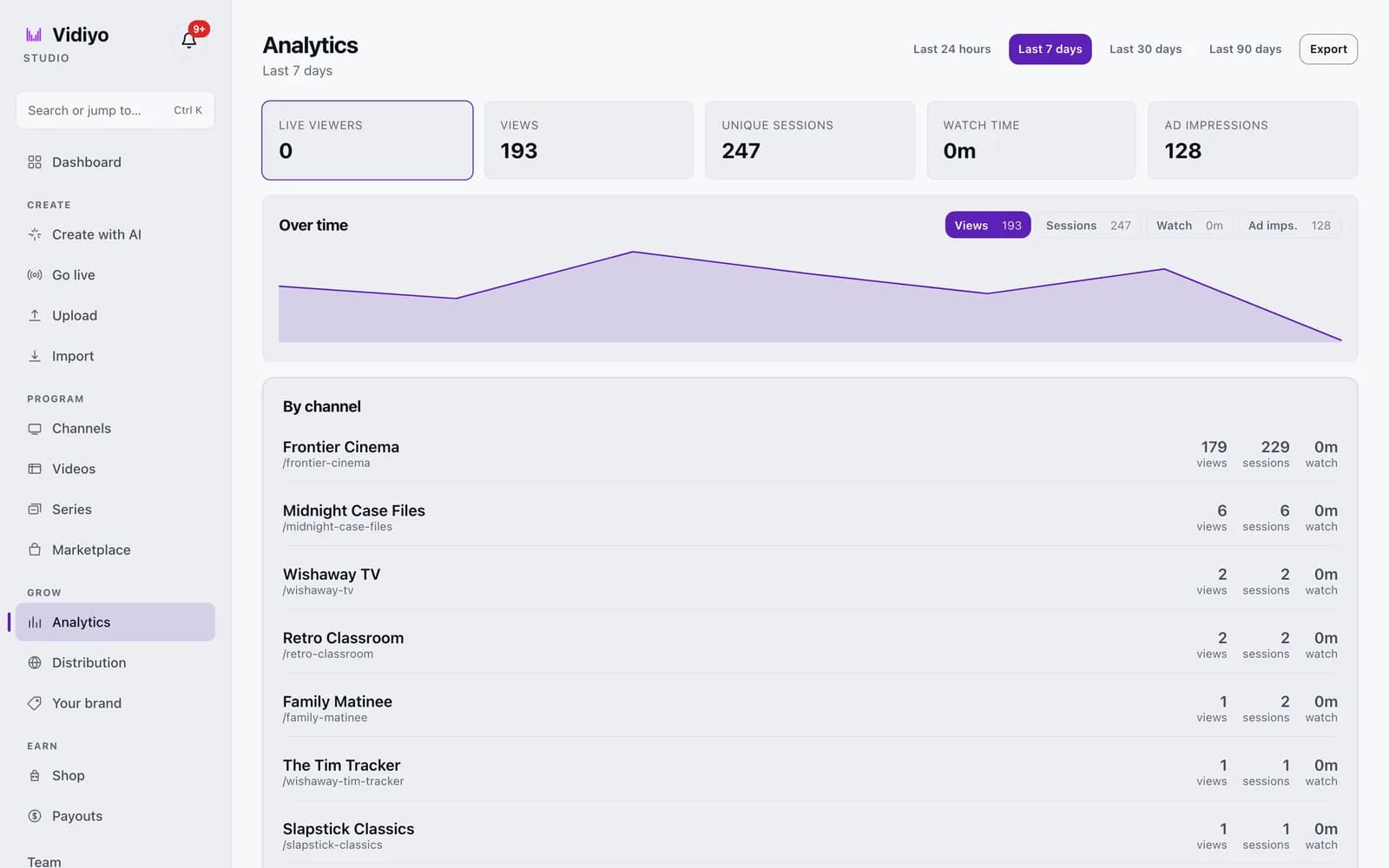
The Studio Analytics page shows five numbers for a 24-hour, 7-day, 30-day, or 90-day window: live viewers right now, views, unique sessions, watch time, and ad impressions. The chart underneath switches between them, and the By channel table breaks the same numbers out per channel so a portfolio operator can see which channel is carrying the views. Export writes the window to a file for the spreadsheet models in the next section.
Each channel also has its own Analytics tab with Overview, Top content, Audience, Revenue, and Retention views, plus embed views by site. Reading it is covered in Read your analytics.
Metrics partners ask for in distribution talks
When you pitch OEM guides or aggregators, bring a simple pack:
- Monthly viewing hours for the last 30 to 90 days
- Average session length by daypart
- Top titles with retention notes
- Uptime / incident notes for the same window
- Caption and ratings compliance status
Partners care less about vanity peaks than about stable, explainable patterns. Distribution context: FAST channel distribution platforms.
Modeling revenue from analytics
A practical stack:
- Take monthly viewing hours from your dashboard
- Estimate ad minutes per hour and impressions per break
- Apply a conservative CPM band for your genre
- Multiply by expected fill rate
- Apply platform revenue share
Worked examples: how much do FAST channels make. Interactive math: FAST revenue calculator. Planning CPM bands: FAST CPM benchmarks 2026.
Operator takeaway
Treat this page as a working checklist, not a one-time read. Revisit it when you change schedule density, ad load, distribution targets, or source quality. Small weekly improvements compound faster than a single big relaunch. If you need a free place to run the channel while you learn, start creating on Vidiyo.
What's next
Ready to launch your TV channel?
Vidiyo handles streaming, ads in the stream, the TV guide, and apps on every screen so you can focus on programming.