 Vidiyo
FAST Channel Monetization: Revenue Models and CPMs
How FAST channel operators make money: SSAI ad revenue, revenue share models, CPM ranges by market and category, ad fill optimization, and what realistic earnings look like at different audience sizes.

FAST channel monetization is almost entirely ad-based. Unlike subscription streaming (Netflix, Hulu) or transactional (iTunes), FAST channels are free to viewers and monetized through advertising, specifically server-side ad insertion (SSAI) into the linear stream.
This guide explains the mechanics of how money flows in FAST, what realistic revenue looks like, and how to optimize it.
How FAST ad revenue works
The basic model:
- A viewer watches your channel
- At scheduled ad break times (usually 2-4 times per hour), your SSAI system calls an ad server
- The ad server auctions the impression to advertisers in real time (programmatic)
- Winning ad plays in the viewer's stream
- Impression beacons fire to confirm delivery
- Revenue is credited to your account
Your FAST platform and ad infrastructure handle all of this. What you configure: when ad breaks happen, how long they run, and which ad server/tag to use.
Revenue share models
How your platform shares ad revenue depends on your arrangement:
Platform-managed monetization (most FAST platforms): The platform sells ads across its entire inventory and shares revenue per channel. You get a percentage of what your channel earns. Common splits: 50/50 or 60/40 (operator/platform). Easier setup, but less control over your rates.
Bring your own ads (BYOA): You connect your own Google Ad Manager account and VAST tags. You keep all direct-sold revenue; the platform may take a fee for SSAI infrastructure. More work, more control.
Hybrid: Direct-sold inventory runs through your ad server; unsold (backfill) inventory is filled by the platform's ad network. Industry-standard for established channels.
Vidiyo uses a revenue share model. Vidiyo monetizes the platform-wide inventory and shares per-channel earnings.
CPM ranges by category and market
CPM (cost per thousand ad impressions) varies enormously by geography, category, time of day, fill rate, and platform. The ranges below are industry estimates based on programmatic CTV data as of 2025-2026. Actual CPMs depend on your specific audience demographics, ad network relationships, and floor price settings. These are not guarantees.
Geography is the biggest factor. US viewers are worth 5-20x non-US viewers to advertisers.
| Market | CPM range (gross) |
|---|---|
| United States | $8–$40 |
| United Kingdom | $5–$15 |
| Canada / Australia | $4–$12 |
| Western Europe | $3–$10 |
| Rest of world | $0.50–$4 |
Content category affects CPM because it determines what advertisers want to be adjacent to:
| Category | Relative CPM |
|---|---|
| News / politics | High ($15-$40 US) |
| Sports | High ($12-$35 US) |
| Cooking / food | High ($10-$25 US) |
| Financial / business | High ($12-$30 US) |
| General entertainment | Medium ($8-$20 US) |
| Music | Medium ($6-$15 US) |
| Gaming | Medium ($7-$18 US, younger demographic) |
| Niche / specialty | Lower ($4-$12 US) |
Daypart matters too. US primetime (8-11 PM Eastern) commands 30-50% higher CPMs than the same content at 2 AM.
Fill rate
Fill rate is the percentage of your ad break inventory that gets filled with paid ads. 100% fill rate = every ad break has a paying advertiser. 0% fill rate = nobody is buying your inventory.
What determines your fill rate:
- Audience size (more viewers = more biddable impressions = higher fill)
- Demographics/targeting (verified US viewers with measurable demographics fill better)
- Content category (news and sports fill better than niche content)
- Ad break structure (too many breaks per hour reduces fill as demand gets exhausted)
- Time of day and day of week
Typical fill rates for a new US-targeted channel:
- First month: 20-40%
- Growing channel (10,000+ monthly hours viewed): 50-70%
- Established channel (100,000+ monthly hours): 70-90%
Unfilled ad breaks earn nothing. You still get the viewer, but no revenue. This is why fill rate is as important as CPM. A channel with a $20 CPM and 40% fill earns less than a channel with a $15 CPM and 80% fill.
Calculating revenue
The formula:
Monthly revenue = Monthly hours viewed × Ad breaks per hour × Fill rate × Ads per break × CPM / 1000
An example for a US-targeted channel:
- 50,000 hours viewed per month
- 4 ad breaks per hour
- 70% fill rate
- 2 ads per break (30-second spots)
- $12 average CPM
50,000 × 4 × 0.70 × 2 × ($12 / 1000) = $3,360 gross
After a 50/50 platform revenue share: ~$1,680/month to the operator.
This math shows why audience development is the primary lever. The same 70% fill rate at $12 CPM with 200,000 hours viewed would be ~$13,440 gross, ~$6,720 to the operator.
Non-ad revenue streams
Ad revenue is the primary model, but not the only one:
Sponsorships. Direct sponsorship deals with brands relevant to your content category. A cooking channel can do branded content deals with food brands, kitchen equipment manufacturers, etc. This revenue is outside the programmatic system and negotiated directly.
Content licensing. Once your channel demonstrates audience, other platforms may want to license your content for their distribution. This is more relevant for original content than acquired content.
Subscription/premium tier. Some FAST operators offer an ad-free subscription version alongside the free ad-supported tier. This requires additional infrastructure but can add meaningful revenue for channels with loyal audiences.
Branded merchandise / direct community. Channels with strong personalities or brands can build direct commerce relationships with their audience. This sits next to FAST ads rather than replacing them.
How the ad share reaches a Vidiyo creator
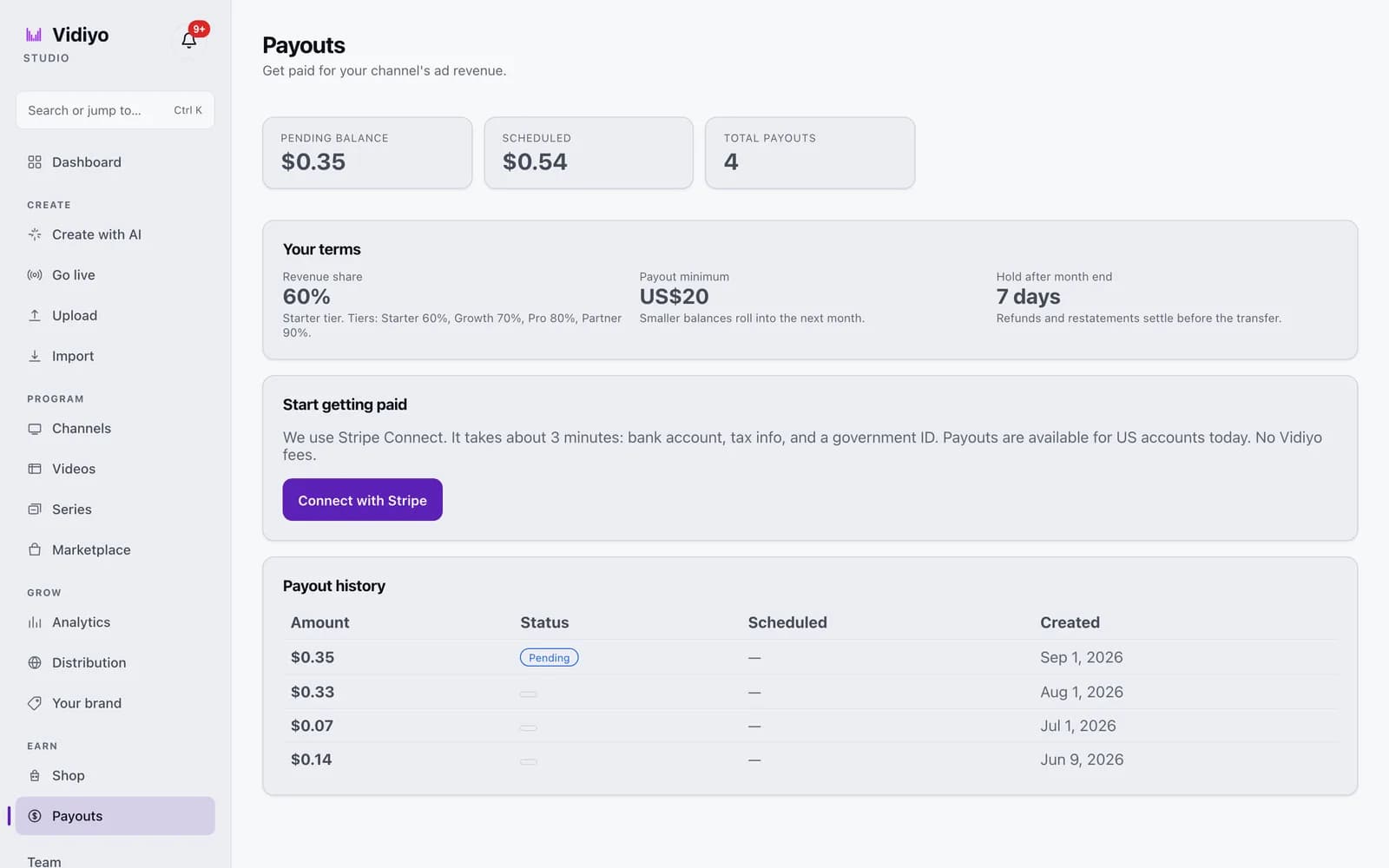
On Vidiyo the revenue share is a tier on the Payouts page, not a negotiation: Starter 60%, Growth 70%, Pro 80%, Partner 90%. Earnings accrue as a pending balance, the month closes, a 7-day hold lets refunds and restatements settle, and balances of US$20 or more transfer through Stripe Connect. Smaller balances roll into the next month. Connecting Stripe takes a bank account, tax information, and a government ID, and Vidiyo charges no fee on the payout. Payouts are available for US accounts today.
The setup steps are in Get paid.
Ad break structure best practices
How many breaks per hour? Industry standard for FAST: 2-4 commercial breaks per hour. Traditional cable and broadcast TV typically runs 15-16 minutes of ads per hour as a market convention (the FCC only limits commercials in children's programming, not adult broadcast TV); most FAST operators run 4-8 minutes per hour to maintain viewer experience and lean-back engagement.
Break length. 2-4 minutes is standard. Longer breaks don't necessarily earn more. If demand is exhausted, additional spots are unfilled or backfilled at near-zero CPMs.
Break placement. Natural narrative breaks (act breaks, between scenes) perform better than mid-sentence interruptions. For content that was produced for broadcast TV, SCTE-35 cue points often align with the original commercial breaks.
Frequency cap. Good ad servers and SSAI platforms enforce frequency capping, limiting how many times a single viewer sees the same ad in a session. Frequency capping reduces viewer fatigue and can improve CPMs.
Optimizing revenue over time
Grow US viewership. US ad dollars dominate programmatic. If your channel has significant non-US viewership, the CPM drag is real. Tailor content, metadata, and discovery for US audiences unless you have a specific reason to target other markets.
Improve content metadata. Better titles, descriptions, and category tags improve ad targeting accuracy, which improves CPMs. An advertiser targeting "home cooking enthusiasts" will pay more for an impression on a viewer watching "How to Make Ramen from Scratch" than on a viewer watching a generically tagged video.
Optimize your EPG. Better EPG metadata (episode titles, descriptions, genre tags) helps TV platforms serve your channel to the right viewers, viewers who are more valuable to advertisers.
Build consistent viewership patterns. Channels with predictable, recurring viewers (people who tune in at the same time every week) command better direct sponsorship rates because you can offer impression guarantees. One-off viral moments are less valuable to direct buyers.
What's next
Ready to launch your TV channel?
Vidiyo handles streaming, ads in the stream, the TV guide, and apps on every screen so you can focus on programming.